Friday, 3 August 2012

ESCAPE FROM THE OLYMPICS

With so much TV airtime devoted to the Olympics, the only way of getting away from it is in the garage listening to Magic 105.4!!


The goods loops on the public viewing side of the layout are taking shape and sidings and warehousing will be added to the right. The slightly odd arrangement is because I do not want any vehicles less than 4" away from the edge of the layout so they are mainly out of the reach of tiny fingers. Scenery will slope up slightly towards the edge of the board.


Looking the other way, we see 58017 with its complete rake of MGR hoppers to test the length of the passing loops.  The wagons are kits from Andy Shillito.  The tracks between the baseboard joins have yet to be tacked down so are not as straight as they should be!


As you can see, four into two are not going to go!  When I buy the points needed to complete this end of the goods loops, I suspect that there will be a slight curve to the right.


Sunday, 22 July 2012

TRACK PLAN

Thanks to Phil Smith, here is the track plan for Alexandra Junction.  As construction progresses, there will no doubt be small changes, but the top seven boards are fiddle yard, and the bottom five are mainly scenic.  It is likely that the two stubs at the front will continue behind the backscene to terminate at buffer stops next to the fiddle yard. There will be tunnel mouths at each end of the scenic section.
The front of the layout comprises the main line and two freight loops.  A line leads off the main line heading to a run round loop. Freights arriving in this loop can run round and disappear into the Docks complex off scene, or shunt into the hidden sidings in a complex of warehouses. How many sidings and whether hidden or not will be determined as track laying progresses.

Tuesday, 17 July 2012

SUN SHINES FOR 10 MINUTES!

Just long enough to get a photo of the latest addition to the heavy haul fleet. 58017 is a Worsley Works etched brass kit with castings from Bruce Hoyle.  The chassis is a 3mm Society brass kit with a centrally mounted DS10 motor driving the outer wheels of each bogie via Branchlines plastic universal joints.

It has been under construction, and awaiting final painting for some years. It is the first loco to use blutac to secure the body to the chassis and so far seems to work quite well deadening out any wobbles and not separating without warning. Transfers are the Woodhead transfers which I commissioned for the Society a number of years ago.

It will hopefully pull 20 (maybe more!) HAA wagons on the new layout and starts a cascade displacing a pair of class 20's which will now power the steel bolsters (a la steel trains which used to run to Boston Docks using class 20s) allowing the second pair of class 20s to replace a class 47 on the Presflos (a la flyash workings to and from West Burton and Fletton brickworks - another well known class 20 turn). The extra capacity offered by Alexandra Junction to show off a further 7 trains over and above Broad Green will allow some of the long rakes of tarted up Tri-ang 4 wheelers to be used with class 37's, 40's and 47's lined up for haulage.


The next locos to appear will be a Class 47, Class 37, and a Class 40 followed by a Western for David Garner which he has waited far too long for but in my defence had trouble with paint turning matt when it should be satin!  after that comes the HST which again has suffered from moody paint problems.

Monday, 4 June 2012

Diamond Jubilee weekend

Tracklaying on the fiddle yards is now complete following delivery of five hand built right hand points from 3mmSMR.


There now follows a break while I continue redecorating the house.  When I return (probably when temperatures fall in the autumn - or when I get bored again with the redecorating!) tracklaying will recommence on the three scenic boards.

I was at an exhibition at the weekend at Woolwich Firepower and the stand next to me was selling a home made version of the Noch flocking system which allows you to create realistic upright grass.  He was doing a demonstration with his version which is a combination of an electric fly swatter and a metal tea strainer.  Noch - £130. Bexley Models - £17.50.

Needless to say, the grass when applied to Alexandra Junction will be pointing upwards! As this wont probably occur for a year or two, you will just have to wait to see the results as the layout is scheduled for completion in time for the 3mm Society 50th anniversary year which is in 2015.

Sunday, 29 April 2012


After an enjoyable meeting of the Woking group of the 3mm Society here on Friday, I set about doing a bit more and here is the result!  The inner fiddle yard is now almost complete except for filling in the gaps with sleepers, and sorting out point control.

Work will now stop for several weeks to await delivery of some hand built points from my friends in 3mmSMR which are the result of some horse trading for some single and double slips, and three way points which in the end I could not use.  These will allow me to finish the outer fiddle yard.

Work will then turn to the scenic section of the layout.  I bought some of the new (ish) backscenes from Gaugemaster at a show the other week and one of these was a lovely (!) industrial scene which I am told is Middlesborough.  I have also asked my friend Howard Love in France if he can build me some terraced housebacks, the sort you still find backing onto the railway in industrial towns.


I also promised a better photo of the master for the class 66 and here it is!

Monday, 23 April 2012

Another couple of weeks have passed and although temperatures remain mild, the rain has hampered my enthusiasm to progress in the garage, but I have been doing some work indoors on locos.

Since the last post, I have laid track on the curved board and rearranged the boards to allow construction to commence on the "missing link" the interlaced interface between the two fiddle yards. I think that there will be the 3mm equivalent of the "Golden Spike Ceremony" when this one is finished!!


This will be the most challenging board on the whole layout with (I think) 16 points to juggle into a 4' x 2' space. I have already made a couple of design changes in order to make the track layout fit the space better - the last point on each fiddle yard now sits on the adjacent board, and the fiddle yard roads will fan out in pairs rather than one after the other.  Phil Smith, who is beavering on a track plan for this site will probably kill me after reading this!

The box at the end of the boards contains points salvaged from my previous layout and hopefully when refurbished, these will form the mainstay of the two throats.  I am still undecided whether to make the blades hanging free, or sprung loaded to save on point motors and wiring or bite the bullet and motorise all these trailing points!  Watch this space!


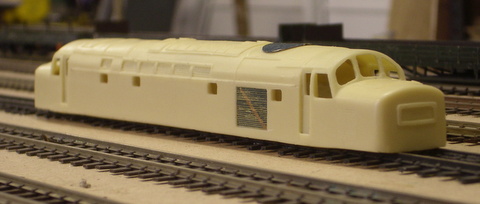
The eagle eyed amongst you might have noticed a couple of resin loco bodies standing on the fiddle yard.  The one on the left is the master for a forthcoming class 66 body kit, and the one on the right and in close up above is a "L" of "L & J" class 40 resin body.  Although I am now getting it to a stage where I am happy with it (just the diagonal bars on the side grilles to go), it has needed a lot of work to make it look the part - especially the windows, main grilles, and fan.  I have used parts from a damaged 3mmSMR etched kit purchased from a fellow Society member last year.
Power will be provided from a pair of Tri-Ang A-1-A motor bogies which have had their side detail ground off on a bench belt grinder and the new sides glued on, plus a pony wheel added.


Hopefully the rain will pass off and I shall be able to get painting SOON!!

Sunday, 8 April 2012


I started doing the curved part of the outer fiddle yard just prior to going on holiday in the week before Easter and thought that readers might like to see the Heath Robinson method of getting the curves right!

The curves start six inches into the two adjoining boards and I nailed two strips of offcuts from laminate floor panelling to join at the centre of the circle and inserted a nail at the point where the lines crossed.  To that nail was attached one end of a length of telephone wire long enough to reach the outer track. The other end was wound round a pencil. I did try string at first but this proved too stretchy. You could also try another baton of wood nailed in at one end and with pencil shaped holes at the right distances.

Starting with the outer track, the first track's centre line was traced and the wire wound in to the centre of the next track and traced. This continued until all tracks were traced onto the board.  Crude but reasonably simple and accurate!

I have now started laying the tracks on boards L (shown) and A (to right).  As there is a change in track used between the board on the left - Peco and Society to match the Peco Points, and board L GEM - as I have about 40 yard lengths to use up - it was not possible to lay across the join between boards K & L which would have been preferable so the alignment is done by eye.